Own project · stonemasonry industry
StoneLab
A stonemasonry platform for customers in Stargard, Goleniów and Szczecin. A catalog of about 215 designs, 25 types of granite, a step-by-step headstone configurator and an online shop with accessories. Prices are stored in a single file.
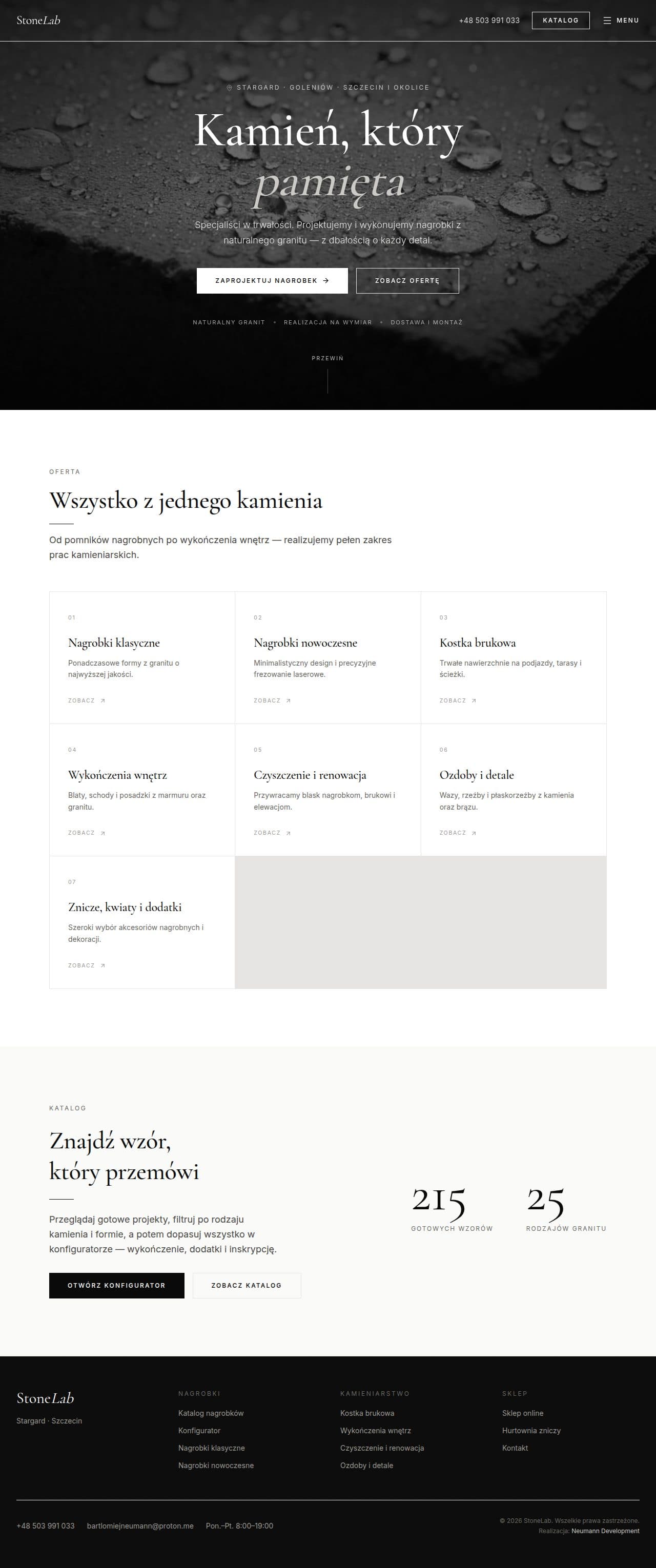
- designs in the catalog
- ≈215
- types of granite
- 25
- offer categories
- 7
- shared price file
- 1
- Configurator
- Catalog
- Shop
- Mobile first
Context
StoneLab is a project of its own in the stone-masonry trade, run from the idea through building the website to contact with the wholesaler.
The platform includes:
- a catalogue of about 215 designs with filtering by type of stone and shape,
- a headstone configurator in which the customer chooses the finish, extras and inscription step by step,
- an offer in 7 categories: classic and modern headstones, paving stones, interior finishes, cleaning and restoration, ornaments and details, and grave candles, flowers and extras from the wholesaler,
- an online shop with accessories.
The process of choosing a headstone is divided into four stages: design, choosing a stone from 25 types of granite, making and installation.
Problem
Headstones are made to order, and their price depends on the design, the type of granite, the finish, the extras and the inscription. Without a configurator, a customer who wants to know the approximate cost usually has to contact a salesperson.
With that many combinations, keeping prices in several places would be hard to maintain. A single outdated value would be enough for the configurator to show a different price from the rest of the site.
Another challenge is organising the fulfilment of orders: stages, deadlines and the scope of work have to be tracked so that no important element is missed.
The mobile version matters too. Customers often browse the offer on phones, so the catalogue and the configurator have to be convenient on a small screen, and not merely look good on a computer.
Technical decisions
- One price file for the whole platform. The project uses neither a backend nor a
database. Prices are stored in
data/prices.jsonand read through a shared function inlib/prices.ts. The catalogue, the configurator and the shop use the same data, so there are no separate price lists, and a price changed in one place applies everywhere. The solution is simpler and cheaper to maintain than a separate database, but every change to the price list requires editing the file and deploying the site again. At the project's current scale that is sufficient. - Limiting JavaScript in the browser. Most of the site is rendered on the server. Only elements that need interaction run in the browser: the animated background in the main section, the changing word in the heading and the counters. The browser therefore has less work to do, which is noticeable on weaker phones.
- Fixing invisible sections. Animations based on
whileInViewcaused some sections to remain invisible on phones after scrolling. Instead of correcting the animation itself, the way of displaying was changed: the content is visible by default, and anIntersectionObserverstarts the animation. Elements already on screen appear straight away, and an additional time limit reveals the rest if the observer fails. Theprefers-reduced-motionsetting was taken into account as well. - Automatic checking of the mobile version. A script detects elements extending beyond the screen width and measures button sizes. A minimum touch area of 44 px was adopted, in line with Apple's and Material Design's recommendations. The script found icon buttons only 16–18 px in size, so their tap area was enlarged. The check can be repeated after further changes to the interface.
- Giving up the 3D animation in the main section. A prototype based on Three.js was not deployed, because on phones it put too much load on the device in relation to the visual effect. A simpler solution was chosen.
- Verification before deployment. Before work on a change is finished, the TypeScript type check and a full project build are run, which makes it possible to catch errors before a new version is published.
Result
StoneLab has a catalogue of about 215 designs, a headstone configurator, seven offer categories and a shop with accessories. All of these parts use a common source of prices, which reduces the risk of discrepancies between the amounts displayed.
The problem of invisible sections was solved by changing the way they are displayed, not by further adjustments to the animation. Basic problems with the mobile layout and the size of touch elements are checked by a script.
Sales through the platform are only just starting, so no figures are given yet. They will be added once real data from the configurator is available.